
A stainless steel wire mesh and powder composite plate is a porous metal plate made by combining stainless steel wire mesh with stainless steel powder, then shaping and bonding them through rolling, folding, pressing, and vacuum sintering. This structure is designed to balance two important needs: permeability for fluid flow and mechanical strength for engineering use.
Porous metal materials are widely used in filtration, fluid control, gas distribution, and structural applications because they combine open pores with the strength of metal. This article explains how stainless steel wire mesh and powder composite plates are prepared, how their porosity and permeability are tested, and how process parameters such as rolling reduction, powder box gap, folding layers, and sintering conditions affect final performance.
What Is a Stainless Steel Wire Mesh and Powder Composite Plate?
A stainless steel wire mesh and powder composite plate, also called an SWMPC plate, is a porous stainless steel plate made from wire mesh reinforcement and stainless steel powder. The wire mesh provides a continuous reinforcing framework, while the powder fills and bonds around the mesh to form a connected porous structure after sintering.
Compared with a plate made only from loose metal powder, the wire mesh helps improve structural support. Compared with a simple mesh layer, the powder helps create a more complex porous network. This makes the composite plate useful when a material needs both fluid passage and mechanical reliability.
In the process discussed here, stainless steel wire mesh and powder composites are first rolled into a porous thin strip. The strip is then folded, pressed, and vacuum sintered to form a porous stainless steel wire mesh and powder composite plate.
Why Combine Stainless Steel Wire Mesh with Powder?
Wire mesh and powder are combined to improve the balance between strength and permeability. Porous metals must allow gas or liquid to pass through, but they also need enough strength to resist handling, pressure, and deformation. Using only high porosity can improve flow, but it may reduce tensile strength and stiffness.
| Component | Main Function | Contribution to Final Plate |
| Stainless steel wire mesh | Reinforcement and skeleton | Improves structural support, tensile behavior, and layer stability |
| Stainless steel powder | Porous matrix and bonding material | Forms pore channels and sintered bonding points around the mesh |
| Vacuum sintering | Metallurgical bonding | Strengthens contact points while preserving the porous structure |
This combined structure is important for metal porous materials, which often need to work as both structural and functional materials. Their performance depends on base metal, porosity, pore architecture, manufacturing method, and sintering conditions.
Materials Used in the Porous Composite Plate
The preparation method uses 304 stainless steel Dutch wire mesh and 304 stainless steel powder. These materials are selected because 304 stainless steel offers corrosion resistance, strength, and durability for porous metal applications.
304 Stainless Steel Wire Mesh
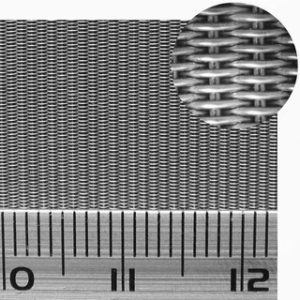
The wire mesh works as the reinforcement in the composite plate. In the study discussed here, 304 stainless steel Dutch wire mesh with a mesh count of 400 threads per inch was used. Its fine mesh structure helps provide both density and mechanical support, making it suitable for creating porous metals.
- Material: 304 stainless steel
- Mesh type: Dutch wire mesh
- Mesh count: 400 threads per inch
- Main role: reinforcement and structural support
304 Stainless Steel Powder
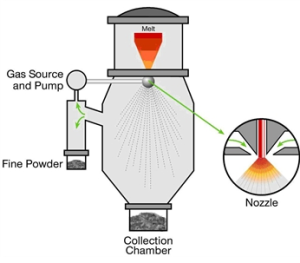
The stainless steel powder is used to fill and bond with the wire mesh during rolling and sintering. The powder described in the study was 304 stainless steel powder prepared by water atomization. Its irregular shape helps create contact points and contributes to the strength and stability of the final porous structure.
- Material: 304 stainless steel powder
- Preparation method: water atomization
- Particle shape: irregular
- Main role: porous matrix and bonding material
Manufacturing Process: Rolling, Folding, Pressing, and Vacuum Sintering
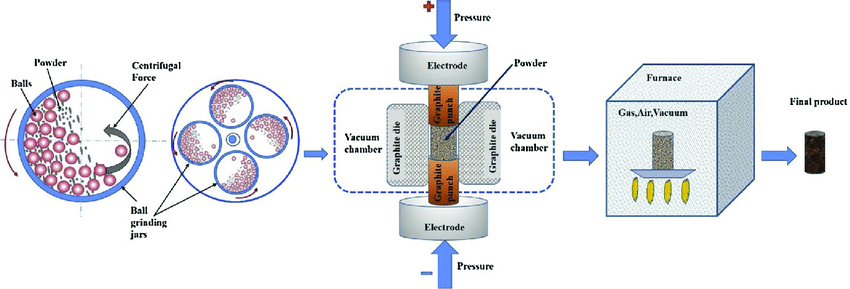
The porous composite plate is prepared by rolling stainless steel wire mesh and powder into a thin strip, then folding, pressing, and vacuum sintering the strip into a plate. Each step controls the final porosity, pore connection, density, and mechanical strength.
1. Rolling the Wire Mesh and Powder
A rolling machine with a maximum rolling force of 240 tons is used to compress the wire mesh and powder into a porous thin strip. The roller gap controls strip thickness and rolling reduction, which affects density, porosity, and bonding between powder and mesh.

2. Layering with a Powder Box
The wire mesh and powder are arranged with the help of an aluminum plate and powder box. The powder box gap affects how much powder is introduced into the rolling zone. A smaller or larger gap changes the powder amount, which then affects the final porosity and strength.
3. Folding and Pressing the Strip
After rolling, the porous strip is folded into multiple layers and pressed. An extruder with 315 tons of pressure is used to compress the folded strip and reduce gaps between layers. Increasing the number of folding layers can improve reinforcement, but the final result still depends on porosity and bonding quality.
4. Vacuum Sintering
Vacuum sintering is the final bonding step. It strengthens the connection between the powder particles and the wire mesh while preserving the porous structure. Higher sintering temperatures generally improve metallurgical bonding and tensile strength, but sintering parameters must be controlled to avoid damaging the desired pore network.
Key Process Parameters That Control Final Properties
The final performance of a stainless steel wire mesh and powder composite plate is controlled by rolling reduction, powder box gap, folding layers, and sintering conditions. These parameters influence porosity, permeability, tensile strength, elongation, and fracture behavior.
| Process Parameter | What It Controls | Effect on Performance |
| Rolling reduction / roller gap | Strip thickness, density, powder compaction | Affects porosity, bonding, and tensile behavior |
| Powder box gap | Amount and distribution of powder | Changes pore volume, density, and material uniformity |
| Folding layers | Layer reinforcement and plate thickness | Can improve tensile strength and elongation when bonding is effective |
| Pressing pressure | Layer contact and gap removal | Improves density and reduces weak interfaces between layers |
| Sintering temperature | Metallurgical bonding between powder and mesh | Higher temperature can improve tensile strength by creating stronger bonding points |
| Sintering atmosphere | Oxidation control and bonding quality | Vacuum conditions help protect the stainless steel during sintering |

How Are Porous Composite Plates Tested?
Porous composite plates are tested by measuring air permeability, porosity, microstructure, and tensile properties. These tests show whether the material has the right balance of flow performance and mechanical strength for engineering applications.
Air Permeability Testing
Compressed air is passed through the porous metal plate to measure how easily air flows through the pore structure. This helps evaluate whether the material is suitable for filtration, gas distribution, restrictors, or fluid-control applications.
Porosity Measurement
Porosity refers to the amount of empty space inside the material. In the article’s test method, porosity is measured using a mass volume method. Higher porosity generally allows greater permeability, but it may also reduce mechanical strength if the structure becomes too open.
Microstructure Observation with SEM
A scanning electron microscope (SEM) is used to observe the microstructure of the composite plate. SEM images help show pore distribution, bonding between powder particles, and the interface between stainless steel powder and wire mesh.
Permeability Coefficient and Darcy’s Law
The relative permeability coefficient describes how easily fluid passes through the material. It can be calculated using Darcy’s Law, which connects flow rate, pressure difference, fluid viscosity, sample thickness, and cross-sectional area. In practical terms, this value helps compare porous plates for filtration or flow-control performance.
Porosity, Permeability, and Strength: What Is the Trade-Off?
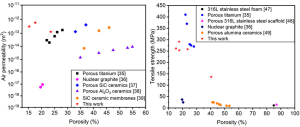
Higher porosity usually improves permeability, but it can reduce tensile strength and stiffness. This is one of the most important trade-offs in porous metal design. A plate with more open space may allow air or liquid to pass more easily, but it may also have less load-bearing metal skeleton.
In this type of composite plate, the wire mesh helps reduce that trade-off by adding reinforcement. The powder creates the porous matrix, while the mesh provides structural support. This is why combining stainless steel mesh and powder is useful for applications that need both flow and strength.
Tensile Properties of Porous Stainless Steel Composite Plates
Tensile properties show how the porous stainless steel composite plate behaves when it is pulled under load. These properties are important for judging whether the plate can withstand handling, installation, pressure, vibration, or structural stress.
One sample discussed in the article, labeled No. S4, had a porosity of 15.35%. Its stress-strain behavior can be understood in four stages:
- Elastic Deformation: The material stretches but can return to its original shape when the load is removed.
- Elastic and Plastic Deformation: Weaker bonded areas begin to deform first, and stress redistributes through the structure.
- Plastic Deformation: The material continues to deform and harden as strain increases.
- Fracture: Cracks form in weaker areas, leading to final failure.
The sintering temperature plays a major role in tensile strength. Lower temperatures can leave weaker bonding points, while higher temperatures can create stronger connections between the stainless steel powder and mesh. The powder box gap and number of folding layers also affect porosity, elongation, and tensile performance.
Potential Applications of Stainless Steel Wire Mesh and Powder Composite Plates
Stainless steel wire mesh and powder composite plates are suitable for applications that require both controlled permeability and mechanical strength. Their value comes from combining a connected porous structure with stainless steel reinforcement.
- Microporous filters: Used where fine flow channels and stainless steel durability are needed.
- Porous restrictors: Used to control gas or liquid flow through a stable porous structure.
- Gas distribution plates: Used to distribute gas evenly across a surface.
- High-temperature filtration supports: Used where stainless steel performs better than plastic or polymer materials.
- Fluid control components: Used in systems where flow resistance, strength, and corrosion resistance all matter.
- Structural porous components: Used where the part must carry load while still allowing fluid passage.
For filtration systems, the final design should be selected according to pore structure, flow rate, pressure drop, corrosion resistance, cleaning method, and mechanical load.
How Does This Composite Plate Compare with Other Porous Metal Materials?
The main advantage of a stainless steel wire mesh and powder composite plate is its reinforced porous structure. Traditional powder-sintered plates can provide good porosity, but they may need reinforcement when mechanical strength is important. Wire mesh plates provide an open metal network, but adding powder can help form a more controlled porous matrix.
| Material Type | Strength | Permeability | Main Advantage |
| Sintered metal powder plate | Moderate to high | Controlled by powder size and sintering | Fine pore control |
| Sintered wire mesh plate | Good | Depends on mesh structure and layers | Stable mesh reinforcement |
| Wire mesh and powder composite plate | Improved by mesh reinforcement | Controlled by porosity, powder amount, and sintering | Balance of permeability and tensile performance |
FAQs About Stainless Steel Wire Mesh and Powder Composite Plates
What does SWMPC mean?
SWMPC means stainless steel wire mesh and powder composite. It refers to a porous plate made by combining stainless steel wire mesh with stainless steel powder, then bonding the structure through sintering.
Why is wire mesh used in porous metal plates?
Wire mesh is used as reinforcement. It helps improve structural support and tensile behavior while still allowing a connected pore structure to form in the composite plate.
How does porosity affect permeability?
Higher porosity usually increases permeability because there is more open space for air or liquid to pass through. However, too much porosity can reduce strength, so the final design must balance flow and mechanical performance.
How does sintering temperature affect tensile strength?
Higher sintering temperature can improve tensile strength by creating stronger bonding between powder particles and wire mesh. However, sintering must be controlled to preserve the required pore structure.
What is Darcy’s Law used for in porous metal testing?
Darcy’s Law is used to calculate permeability from flow rate, pressure difference, viscosity, sample thickness, and area. It helps compare how easily fluids pass through different porous plates.
Where can these porous composite plates be used?
They can be used in microporous filters, porous restrictors, gas distribution plates, high-temperature filtration supports, and fluid-control components where both permeability and stainless steel strength are required.
Conclusion
Stainless steel wire mesh and powder composite plates offer a practical way to balance porosity, permeability, and tensile strength in porous metal materials. The wire mesh provides reinforcement, the powder forms the porous matrix, and vacuum sintering creates bonding while preserving open flow paths.
The key finding is that process parameters matter. Higher porosity improves permeability, while stronger sintering and effective folding can improve tensile performance. Roller gap, powder box gap, folding layers, pressing pressure, and sintering conditions all influence the final plate structure.
For filtration and engineering applications, this type of porous stainless steel composite plate is valuable because it combines controlled fluid passage with metal durability. It gives engineers a useful design direction for porous filters, restrictors, support plates, and other components that must handle both flow and mechanical stress.