
Choose data center liquid cooling filters by loop, particle retention, flow, pressure drop, coolant compatibility, and maintenance needs. In liquid-to-liquid CDU systems, facility-side and server-side filtration protect different components and require separate specifications.
For a CDU manufacturer or cooling system integrator, the practical goal is to protect downstream equipment while maintaining the required coolant flow. Saifilter offers stainless steel pipeline strainers with Y-type, straight-through, and angle-type bodies, removable elements, and screen options selected for the application. This guide explains how to evaluate those configurations for single-phase liquid cooling projects, with facility-water screening as the main application.
Which Filters Are Used in Data Center Liquid Cooling?
A useful starting point is the equipment immediately downstream of the proposed filter. A coolant distribution unit (CDU) with a liquid-to-liquid heat exchanger separates the facility water system (FWS) from the technology cooling system (TCS) serving the IT equipment. A strainer on the FWS inlet screens the water entering the primary side of the heat exchanger. It cannot remove particles already circulating in the separate TCS.
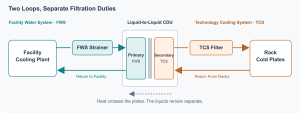
Simplified liquid-to-liquid CDU arrangement. Pumps, valves, and controls are omitted; exact filter positions depend on the equipment design.
The broader cooling system may also include a condenser water system (CWS). Select filtration for each loop according to its water source and the equipment it serves:
| Loop | Equipment to Protect | Filtration Decision |
| CWS, where present | Condensers and other equipment exposed to tower-water debris | Match coarse filtration and solids capacity to the water source and flow. |
| FWS at the CDU inlet | Primary-side heat exchanger and downstream components | Select a strainer or filter against the CDU’s inlet requirements. |
| TCS serving the racks | Cold plates and other coolant passages | Use the retention performance specified by the IT and cooling equipment manufacturers. |
Saifilter’s removable elements use perforated metal for coarse screening or woven mesh with perforated support for smaller openings. Select the element for the protected component’s particle-retention requirement and the flow conditions at that point in the loop.
What Micron Rating Does a CDU Filter Need?
There is no single micron rating for every CDU filter. The required rating depends on the loop and the equipment being protected. For an FWS inlet, start with the CDU supplier’s requirement. For a TCS filter, use the retention requirements for the cold plates, connectors, and other downstream components.
Understand Mesh, Aperture, and Filter Ratings
Mesh count describes the number of openings per linear inch. Wire diameter and weave also affect the clear opening. For a Saifilter strainer, specify both the mesh and its aperture. These screen options show why the two values belong together:
| Mesh Count | Wire Diameter | Screen Aperture |
| 100 | 0.100 mm | 154 µm |
| 200 | 0.053 mm | 74 µm |
| 400 | 0.025 mm | 38.5 µm |
These values apply to the listed screen constructions. The 400-mesh example has a 38.5 µm geometric opening; it does not establish a 25 µm absolute filtration rating.
A geometric aperture describes an opening in the screen. A retention claim also needs an efficiency and test basis. When comparing nominal or absolute ratings, request the particle size, removal efficiency, test method, and test fluid so the ratings can be compared on the same terms.
Saifilter’s published 10–400 mesh range gives buyers a choice of screen constructions. A perforated cylinder can provide coarse screening or support a finer woven mesh layer. Selecting the opening together with its support makes the requirement specific enough to evaluate hydraulically and mechanically.
How Do You Size a Liquid Cooling Strainer?
Size the strainer for the required flow through the complete housing and element. Connection size establishes the piping interface; it does not establish the available screening area or the pressure drop of the selected assembly.
Evaluate Pressure Drop at the Required Flow
The hydraulic review needs normal and maximum flow, coolant composition, density, viscosity, and operating temperature. The resulting pressure-drop data should identify the housing, element, and screen construction used.
A water curve for an unlined perforated screen cannot simply be applied to a mesh-lined element handling glycol. Use data for the selected construction and fluid conditions, or a calculation that accounts for the differences. This keeps the pressure-drop estimate tied to the assembly that will actually be installed.
Allow for Solids Loading
As debris collects, the available flow area decreases. The system needs enough pressure margin to maintain its required flow until the planned service point. Establish both the acceptable clean pressure drop and the maximum operating pressure drop before cleaning.
A larger screening area can help offset the restriction of a finer screen, although the complete assembly still needs hydraulic evaluation. Open area matters too: it is the portion of the screen available for flow. A perforated support has its own open area, so the review must account for both the mesh and its support. The selected assembly still needs room in the piping layout.
Separate Operating Pressure From Differential Pressure
Three pressure values belong in the specification:
- Housing pressure limit: the internal pressure the complete assembly is rated to contain at the specified temperature.
- Element differential-pressure limit: the pressure difference the screen and its support can withstand.
- System pressure-drop allowance: the restriction the cooling system can tolerate while delivering the required flow.
A high housing pressure rating cannot establish the other two values. Saifilter’s operating limits are configuration-specific, and its general product information does not supply a standard pressure-drop curve. A configuration-specific calculation or test result is therefore needed to complete the hydraulic selection.
Which Strainer Design Fits Your Piping?
Choose the body around the required flow direction and the space needed to remove the element. Saifilter offers three arrangements that address different piping layouts:
| Design | Piping Arrangement | Space Needed for Service |
| Y-Type Strainer | Main connections remain in line; the screen occupies an angled chamber. | Clearance to open the angled chamber and withdraw its full element. |
| Straight-Through Strainer | Inlet and outlet share the same axis. | Clearance at the service end for cover and element removal. |
| Angle-Type Strainer | Inlet and outlet form a 90-degree turn. | Clearance at the service opening as well as room for the pipe turn. |
Mark the complete removal space on the piping drawing. A body can fit between two connections yet leave the element trapped behind a wall, valve, or adjacent pipe. The order drawing should show the approved orientation, connection standard, installed dimensions, and service access.
An angle body is a useful candidate when the filtration point already needs a change in direction. A coaxial pipe run leads to a comparison of the Y-type and straight-through arrangements. Their hydraulic performance must be evaluated with the selected screens; body shape alone cannot establish which has the lowest pressure drop.
Which Materials Are Compatible With Your Coolant?
Material selection must cover the complete wetted assembly: housing, screen, support, seals, and connections. A coolant description should identify the actual formulation and concentration, including inhibitors or other additives, together with its temperature range.
Saifilter offers 304 and 316L stainless steel constructions, with seals and connections selected for the application. Those options allow the proposed assembly to be matched to a project specification. Neither steel grade alone establishes compatibility with every glycol formulation or treatment program.
Specify the surface finish and delivered cleanliness for the proposed Saifilter assembly alongside its material grade. A sanitary finish alone does not establish suitability for a particular CDU or server cooling loop; the complete assembly, including its seals, must meet that loop’s coolant and cleanliness requirements.
Saifilter also lists an optional insulation jacket. Where cold surfaces require insulation, include the strainer and its service opening in the site’s insulation design. Condensation control depends on the operating temperatures, ambient dew point, and completed insulation system.
Can You Service the Strainer Without Stopping Cooling?
A Saifilter manual strainer requires its own flow path to be isolated for cleaning. Cooling can continue only if the system has an approved alternative that maintains the required flow and filtration while that path is unavailable. Depending on the system design, that could involve a duplex arrangement or redundant cooling branch.
Saifilter’s removable element provides access for inspection and cleaning without cutting the housing out of the pipe. Before opening the service cover, the housing must be isolated, depressurized, and drained under the approved site procedure. A quick-opening closure does not permit opening a pressurized assembly.
Set Cleaning and Replacement Criteria
Establish a clean baseline, then trend flow and differential pressure under comparable coolant and temperature conditions. Set the service trigger below the applicable element and system limits. A fixed calendar interval alone cannot account for changing debris loads.
During service, inspect the screen, support, welds, seating surfaces, and gasket. Reuse depends on their condition; damaged media or seals need replacement. An approved spare element can be exchanged while the removed element is cleaned separately, with the isolation and restart work still included in the maintenance plan.
Cleaning must preserve the loop’s cleanliness. Use cleaning fluids and procedures approved for the coolant system, remove residues as required, and protect the cleaned element during storage and handling.
For procurement, compare replacement elements, seals, cleaning labor, and the cooling arrangements needed during service alongside the initial purchase price.
A CDU Inlet Strainer Selection Example
Suppose an FWS branch supplying a liquid-to-liquid CDU needs a 90-degree turn at the filtration point. The branch can be isolated during an approved maintenance window, and the CDU supplier has specified the screen opening.
The Saifilter angle-type strainer is a reasonable layout candidate because its inlet and outlet provide that turn. The designer places the proposed housing on the piping drawing and reserves the full removal space in the direction shown on the assembly drawing. If an adjacent pipe blocks that space, the installation needs a revised layout before the angle body can be selected.
The specified opening then becomes an element requirement, including the screen construction and support. Normal and maximum flow, coolant properties, and the clean and service pressure-drop allowances go into the hydraulic review. The selected materials, seals, and connections must also satisfy the branch’s operating conditions.
The result is a defined configuration for technical approval: an angle body, an identified element, and a drawing showing how it will be installed and maintained. Selection is complete when the proposed assembly meets the hydraulic and mechanical requirements. If the piping instead requires coaxial connections, the Y-type and straight-through bodies become the layout candidates.
What Should You Include in a Saifilter Strainer Inquiry?
Give Saifilter the operating conditions and installation constraints needed to define the proposed assembly. The following inquiry checklist connects each project requirement with the technical information needed for selection:
| Provide With the RFQ | Request in the Technical Response |
| Cooling loop, protected component, and filtration requirement | Element construction, aperture or retention rating, and applicable performance evidence |
| Coolant formulation, concentration, temperature, and flow range | Pressure-drop data or calculations for the proposed configuration, with conditions stated |
| Operating and design pressure, temperature, and differential-pressure limits | Confirmed limits for the housing, element, seals, and closure |
| Pipe size, connection standard, orientation, and available space | Assembly drawing showing connections, dimensions, and removal clearance |
| Materials, cleanliness, inspection, and documentation requirements | The materials and inspection documents included in the offer |
| Maintenance plan and required delivery schedule | Service instructions, replacement part details, prices, and lead times |
Keep units explicit, such as US gpm and L/min for flow, and psi and kPa for pressure. Identify the connection standard alongside the nominal size. A Saifilter quotation should identify the selected element, material, interface, and documentation scope so the proposed configuration can be reviewed against the project requirements.
FAQs About Data Center Liquid Cooling Filters
Does a Cooling Loop Still Need Flushing If It Has a Filter?
Yes. Permanent filtration does not replace commissioning flushes. Construction debris can overload filters or reach sensitive components. Follow the equipment manufacturer’s flushing and cleanliness requirements before connecting servers, using temporary filtration where the commissioning plan requires it.
Does a Liquid Cooling Filter Replace Coolant Treatment?
No. A particulate filter removes suspended solids within its rated performance. It does not control pH, dissolved salts, or inhibitor levels. Coolant testing and treatment must still follow the equipment and coolant suppliers’ requirements.
Can Side-Stream Filtration Replace a Full-Flow Strainer?
Not automatically. A side-stream filter treats part of the circulating flow, while a full-flow strainer intercepts particles in its entire flow path. Use side-stream filtration as a replacement only if the approved system design supports that arrangement.
Can a Saifilter Strainer Replace an Existing CDU Inlet Strainer?
It may be suitable after a technical review. The proposed Saifilter assembly must match the inlet’s retention, pressure-drop, material, sealing, and operating requirements, with compatible connections and service clearance. Any CDU approval conditions still apply.
Does Adding More Racks Require a Larger Liquid Cooling Filter?
Not necessarily. Reassess the affected loop’s flow and pressure-drop budget after expansion. The existing filter may remain suitable within its qualified operating range; otherwise, the system may need added filtration capacity or a different arrangement.